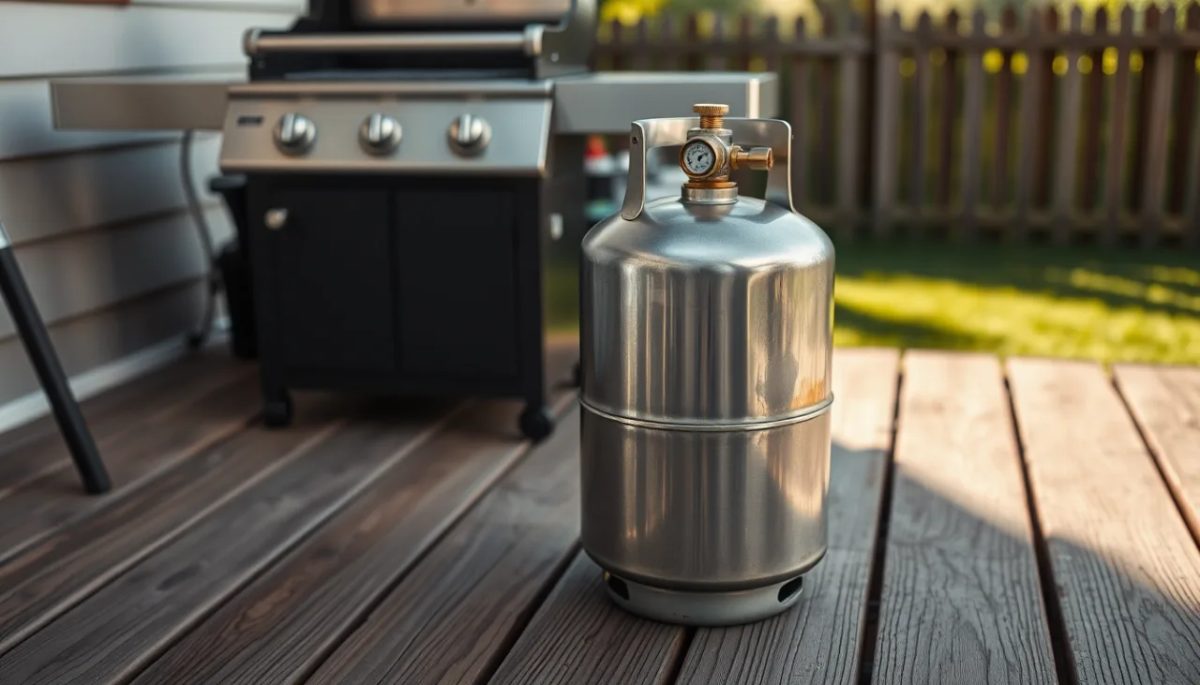
How Much Is It to Fill a Propane Tank? Costs by Size
Filling a standard 20-pound grill tank usually costs $13 to $25. It holds about 4.7 gallons, and most refill stations charge roughly $2.80 to $4.20 per gallon. A 30-pound tank runs about $22 to $35 and a 100-pound cylinder about $60 to $120. Large home tanks cost hundreds of dollars per fill, depending on tank size and the local per-gallon price.
Propane refill cost by tank size
Propane is sold by the gallon, but portable tanks are labeled by pounds of propane. One gallon weighs about 4.2 pounds, so you can turn any cylinder’s rating into gallons and multiply by the posted price. The ranges below assume an empty tank filled at a typical refill station.
| Tank size | Propane it holds | Typical refill cost | Common uses |
|---|---|---|---|
| 20 lb | About 4.7 gallons | $13–$25 | Gas grills, patio heaters, fire pits |
| 30 lb | About 7.1 gallons | $22–$35 | RVs, campers, larger heaters |
| 40 lb | About 9.4 gallons | Roughly $26–$40 at the same per-gallon rates | RVs, food trucks |
| 100 lb | About 23.6 gallons | $60–$120 | Small home appliances, generators, cabins |
The 100-pound range is wide because these cylinders are often refilled through propane dealers or delivery services. Those businesses may add a service or delivery charge, which a walk-up refill counter does not.
What home propane tanks cost to fill
Large residential tanks are rated by water capacity, not propane capacity. For safety, they are filled to only about 80% so the propane has room to expand. A “500-gallon” tank holds about 400 gallons of propane when full.
The table uses two sample per-gallon prices to show how the math works. These are examples, not quotes. Delivered home prices vary widely by state, by supplier and by season.
| Tank size (water capacity) | Max propane at 80% | Cost at $2.50/gal | Cost at $3.50/gal |
|---|---|---|---|
| 120 gallons | About 96 gallons | About $240 | About $336 |
| 250 gallons | About 200 gallons | About $500 | About $700 |
| 500 gallons | About 400 gallons | About $1,000 | About $1,400 |
| 1,000 gallons | About 800 gallons | About $2,000 | About $2,800 |
Most deliveries are not filled from empty. Drivers top off whatever is missing. If your 500-gallon tank gauge reads 20%, you would need about 300 gallons to get back to 80%. At $2.55 a gallon, that comes to roughly $765.
The gauge on a home tank shows a percentage of the tank’s total capacity. To estimate a fill, use this formula: (80 minus your gauge reading) ÷ 100 × tank size × price per gallon.
Refill vs. exchange: which is cheaper?
For a 20-pound grill tank, refilling almost always costs less. Exchange cages at grocery stores, home centers and gas stations swap your empty tank for a pre-filled one. Those tanks usually hold only about 15 pounds of propane, not 20.
Here is a worked example:
- Exchange: about $20–$25 for roughly 15 pounds, or about 3.5 gallons. That works out to about $5.70–$7.10 per gallon.
- Refill: 4.7 gallons at $3.50 per gallon is about $16.50 for a full 20 pounds.
That means you pay more and get about a quarter less fuel with an exchange. Refilling has another advantage. If your tank still has propane in it, you pay only for what goes in. An exchange gives no credit for leftover fuel.
Exchange still makes sense in some situations:
- It is the only option open late or nearby.
- Your tank is past its requalification date or has a damaged or outdated valve. An exchange gets you a certified tank without buying a new one.
- You value grabbing a tank in two minutes over saving money.
Where to get a propane tank filled
- Warehouse clubs (Costco, BJ’s): often the cheapest at about $13–$15 for a 20-pound tank, or roughly $2.80–$3.10 per gallon. You need a membership, and not every warehouse has a propane station.
- U-Haul: refills propane at more than 1,200 locations with no membership. Expect about $14–$19 for a standard 20-pound fill, at roughly $3.00–$4.00 per gallon.
- Tractor Supply: common in rural areas. It charges by the actual gallon, without flat fees or minimums.
- Local propane dealers: often competitive per gallon. They can usually fill 100-pound cylinders and inspect or requalify older tanks.
- Walmart, hardware stores, gas stations: mostly exchange cages, such as Blue Rhino and AmeriGas. Some locations also refill. Prices vary by store, so check the posted board or call ahead.
What drives the price up or down
- Season: home propane demand peaks in winter, and prices often rise with it. Grill-tank prices can also climb before summer holidays.
- Location: rural areas far from supply terminals and states with heavy winter demand often pay more. Competition matters too. A town with three refill stations tends to be cheaper than one with a single option.
- Flat-rate vs. by-the-gallon pricing: some counters charge a flat fee for a “full” 20-pound tank regardless of what’s left in it. By-the-gallon pricing is better if your tank isn’t empty.
- Volume: home customers who buy more per year, prepay or lock in a price before winter often get a lower rate per gallon.
Hidden and extra costs
The per-gallon price is not always the full bill. This is especially true for home delivery. Ask about:
- Minimum charges: some refill counters charge a minimum, so topping off a half-full tank may cost as much as a full fill.
- Delivery or small-delivery fees: charged when an order falls below the supplier’s minimum gallons.
- Tank rental: an annual fee if the supplier owns your home tank. This can be waived above a certain yearly usage.
- Hazmat, fuel or regulatory surcharges: small line items that add up over a season.
- After-hours or emergency delivery: often a steep premium if you run out.
- Leak check or safety inspection fees: typically required after you run a home tank completely empty. Some suppliers also require them when starting service.
- Tank requalification or valve replacement: needed if a portable cylinder is too old to legally refill.
Tips before you pay
- Check the date stamped on the tank collar. A portable DOT cylinder can be refilled for 12 years from its manufacture date. After that, it must be requalified before anyone will fill it. If yours is close, exchanging may cost less than requalifying.
- Look for the triangle-shaped valve handle. That shape means the tank has an overfill protection device (OPD). Tanks from 4 to 40 pounds need one to be refilled. Older round or five-point handles are a sign you will be turned away.
- Ask “Is that per gallon or flat rate?” If it is flat rate and your tank isn’t empty, find a by-the-gallon station instead.
- Weigh before you go. Subtract the tare weight (TW) stamped on the collar from the tank’s current weight. That tells you how many pounds are left. Divide by 4.2 for gallons, and you will know roughly what the fill should cost.
- For home tanks, get two or three quotes for the same gallons. Ask each supplier for the total including all fees, not just the per-gallon price. Check the weekly residential propane prices the US Energy Information Administration publishes during heating season to see whether a quote is out of line.
Never try to refill a cylinder yourself or remove a stuck valve. Refills should be done by trained attendants. If you smell gas around a home tank, leave the area and call your propane supplier or 911 from a safe distance.
FAQ
– How much does Walmart charge to refill propane?
Most Walmart stores offer tank exchange through cages rather than refills. Exchange prices generally fall in the same range as other exchange programs, about $20 to $25 for a roughly 15-pound tank. Some locations do offer refills, so call your store to confirm the service and current price.
– How much does it cost to fill up a 100-gallon propane tank?
A 100-gallon home tank is filled to about 80 gallons. That is roughly $200 at $2.50 a gallon or $280 at $3.50, before any delivery fees. Don’t confuse this with a 100-pound cylinder, which holds only about 23.6 gallons and costs $60 to $120 to fill.
– How much does it cost to fill a 20-lb propane tank at Tractor Supply?
Tractor Supply charges by the gallon with no minimum or flat fee. Your cost is simply the posted price times the gallons pumped, up to about 4.7 gallons for an empty 20-pound tank. Prices vary by store, so check the local rate before you go.
– How long does a 20-lb propane tank last on a grill?
It depends on the grill’s burner size and how high you cook. A full tank commonly lasts somewhere around 18 to 20 hours on a medium-size grill. Weighing the tank against its tare weight is the most reliable way to know how much is left.